Aeronautical Metrology • Code F Aerodrome Standards
Airliner Size Comparison: The Giants of Aviation
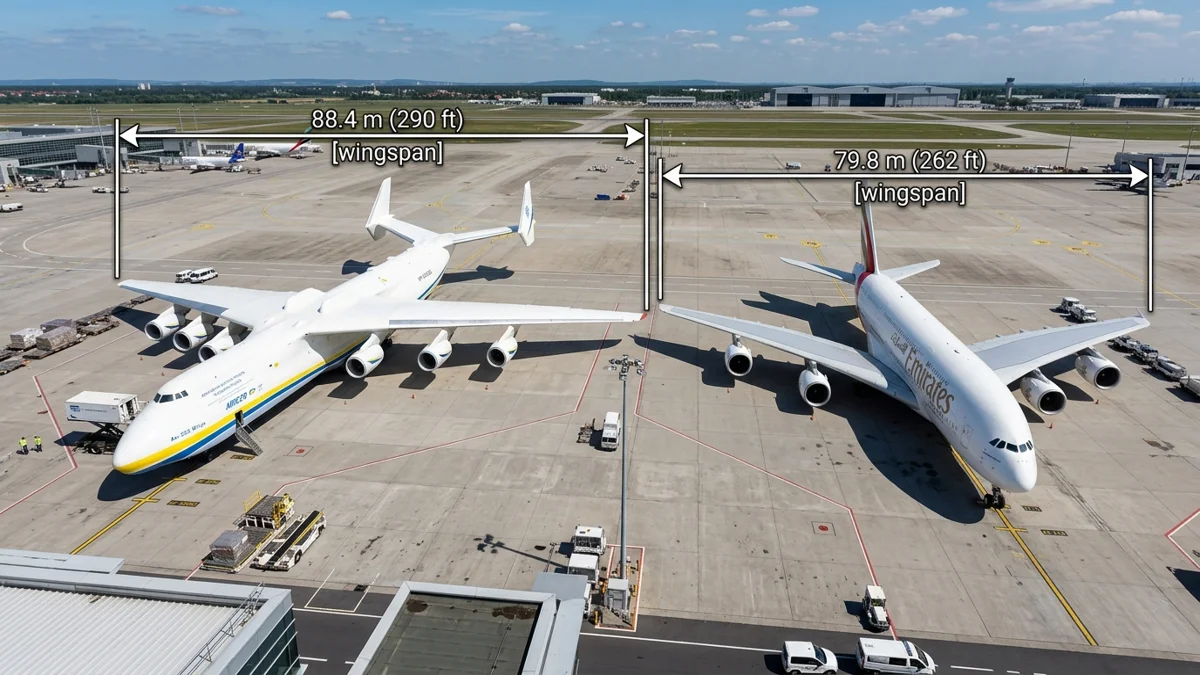
Proportional dimensional scale models, wingspan deltas, and airport apron footprint evaluations comparing the Antonov An-225, Airbus A380, and Boeing 747-8.
FAA Part 25 & EASA CS-25 Certified Specifications
•
Verified OEM Planning Data: Boeing APD & Airbus FCOM
•
ICAO Doc 9157 Aerodrome Standards
The Square-Cube Law & The Physical Boundaries of Airframe Scaling
In aeronautical structural mechanics, the square-cube law dictates that as an airframe scales proportionally in linear dimensions, its wing surface area scales by the square, whereas its structural volume and mass scale by the cube. Consequently, giant airframes such as the Airbus A380 and Boeing 747-8 experience disproportionately higher empty structural weights per passenger seat unless mitigated by revolutionary materials science. The transition from traditional aluminum-copper alloys to advanced carbon-fiber reinforced composites, titanium-aluminide turbine blades, and high-aspect-ratio raked wingtips has enabled modern twin-engine airliners like the Boeing 777-9 to deliver comparable cabin payloads at substantially lower operational empty weights (OEW) than legacy four-engine superjumbos.
Aerodynamic Scaling LawsSquare-Cube Law • Code F Gate Clearances • OEW Structural Mass
ICAO Annex 14 • Aerodrome Design Manual
Beyond internal aerodynamic limits, external aerodrome physical boundaries define the economic viability of ultra-large aircraft. International airports adhere strictly to International Civil Aviation Organization (ICAO) Aerodrome Design Manual standards. Gate spacing, taxiway centerline radius fillets, bridge height limits, emergency aircraft rescue and firefighting (ARFF) index categories, and apron jet-blast deflector structures impose rigid upper constraints on commercial aircraft length, wingspan, and tail fin height.
Heavy Transport Architectural Telemetry
Antonov An-225 Mriya
Certified heavyweight airframe engineered for ultra-high-density commercial transport or strategic outsize logistics, balancing wingspan aerodynamic aspect ratios against worldwide airport ground compatibility.
Heavy Transport MetrologySuper Wake Envelopes • 640t MTOW • Code F Taxiway Fillets
Aerodrome Metrology & Wake Envelopes
ICAO Aerodrome Reference Code F Specifications
Commercial transports with wingspans between 65 meters and 80 meters (or outer main gear wheel span between 14 meters and 16 meters) belong to ICAO Aerodrome Code F. Accommodation requires minimum 60-meter wide runway surfaces with 7.5-meter paved shoulders to prevent jet blast foreign object ingestion. Taxiway centerlines must provide 17.5 meters of physical obstacle clearance to ensure safe wingtip separation during concurrent ground taxi operations.
Super Wake Turbulence Vortex Categories
Vortices generated by heavyweight superjumbos present severe hazardous crosswind shear to trailing aircraft. The FAA and ICAO established the 'Super' wake category specifically for the Airbus A380-800 and Antonov An-225. Trailing Heavy jets require minimum 6 to 8 nautical miles of in-trail radar separation behind an A380 on final approach, while light regional aircraft require up to 10 nautical miles or 4 full minutes of runway departure hold interval.
Main Landing Gear Pavement Loading & ACR/PCR
Distributing up to 575,000 kg of gross weight across airport concrete demands specialized multi-bogie landing gear architecture. The A380 deploys four main gear bogies with 20 wheels, while the An-225 featured a 32-wheel arrangement with steerable rear axles. Modern aerodromes rate aprons using the ICAO Aircraft Classification Rating - Pavement Classification Rating (ACR/PCR) system, preventing subgrade soil failure during prolonged ground parking under fully fueled conditions.
Ground Maneuverability StandardsCode E vs Code F Clearances • ACR/PCR Pavement Telemetry
ICAO Annex 14 • FAA AC 150/5300-13B
Ground Gate Physics & Apron Turnaround Dynamics
Folding Wingtips & Code E Gate Transition
To avoid Code F gate penalties that hindered commercial sales of earlier superjumbos, the Boeing 777-9 features 3.5-meter folding wingtips. With wingtips extended during flight, its 71.75-meter wingspan operates at high aspect-ratio cruise efficiency. Upon runway rollout, flight deck actuators fold the wingtips vertically, reducing ground span to 64.82 meters and granting seamless access to existing standard Code E airport gates worldwide without costly airport terminal reconstruction.
Empennage Vertical Fin Height & Hangar Clearances
Aircraft tail height represents a primary limiting factor for maintenance hangar architecture. The Airbus A380-800 measures 24.09 meters (79 feet) to the top of its vertical stabilizer, requiring specialized high-bay hangars with notched overhead doors. Ground taxi clearance beneath elevated airport passenger skybridges (such as Munich Airport or Denver International Airport) necessitates at least 26 meters of vertical airspace. Maintenance facilities must incorporate dedicated multi-level tail-dock staging platforms to inspect upper rudder actuators and electronic flight control wiring.
Refueling ultra-large commercial aircraft demands industrial apron fuel hydrant infrastructure. With a fuel capacity of 320,000 liters (84,500 US gallons), an Airbus A380 requires dual high-pressure hydrant pit dispensers pumping concurrently at 2,000 liters per minute per hose. Total fuel upload can take up to 45 minutes of active delivery. Ground turnaround operations require simultaneous catering provisioning across upper and lower cabin decks via high-lift scissor trucks, dedicated ground power units (GPU), and pre-conditioned air (PCA) carts to maintain cabin environmental comfort without auxiliary power unit (APU) emissions.
Heavy Commercial & Strategic Transport Dimensional Matrix
Aircraft Model
Primary Category
Wingspan (m)
Length (m)
MTOW (kg)
ICAO Aerodrome Code
Antonov An-225 Mriya
Strategic Outsize Freighter
88.4 m
84.0 m
640,000 kg
Code F (Special)
Airbus A380-800
Double-Deck Superjumbo
79.75 m
72.72 m
575,000 kg
Code F
Boeing 747-8 Intercontinental
Widebody Passenger / Cargo
68.4 m
76.3 m
447,700 kg
Code F
Boeing 777-9X
Long-Range Widebody Twinjet
71.75 m (64.8m folded)
76.72 m
351,534 kg
Code E (Ground) / Code F (Air)
Lockheed C-5M Galaxy
Military Strategic Transport
67.89 m
75.31 m
381,000 kg
Military Heavy
Hughes H-4 Hercules
Experimental Flying Boat
97.82 m
66.65 m
181,437 kg
Historical Flying Boat
Entry #1Antonov An-225 Mriya
Primary Category Strategic Outsize Freighter
Wingspan (m) 88.4 m
Length (m) 84.0 m
MTOW (kg) 640,000 kg
ICAO Aerodrome Code Code F (Special)
Entry #2Airbus A380-800
Primary Category Double-Deck Superjumbo
Wingspan (m) 79.75 m
Length (m) 72.72 m
MTOW (kg) 575,000 kg
ICAO Aerodrome Code Code F
Entry #3Boeing 747-8 Intercontinental
Primary Category Widebody Passenger / Cargo
Wingspan (m) 68.4 m
Length (m) 76.3 m
MTOW (kg) 447,700 kg
ICAO Aerodrome Code Code F
Entry #4Boeing 777-9X
Primary Category Long-Range Widebody Twinjet
Wingspan (m) 71.75 m (64.8m folded)
Length (m) 76.72 m
MTOW (kg) 351,534 kg
ICAO Aerodrome Code Code E (Ground) / Code F (Air)
Entry #5Lockheed C-5M Galaxy
Primary Category Military Strategic Transport
Wingspan (m) 67.89 m
Length (m) 75.31 m
MTOW (kg) 381,000 kg
ICAO Aerodrome Code Military Heavy
Entry #6Hughes H-4 Hercules
Primary Category Experimental Flying Boat
Wingspan (m) 97.82 m
Length (m) 66.65 m
MTOW (kg) 181,437 kg
ICAO Aerodrome Code Historical Flying Boat
Scale comparison of world largest commercial heavy airlifter and passenger jets
Heavy Transport Scale Metrology: Proportional wingspan, fuselage length, and MTOW comparison.
P1 Flight Operations Suite
Aeronautical Calculators & Telemetry Envelopes
Crosswind Vector10.0 kts
Headwind / Tailwind Vector17.3 kts Headwind
Wind Angle Offset (Δθ)30°
Pressure Altitude (PA)2,500 ft
Density Altitude (DA)4,894 ft
ISA Temperature Deviation+20.0°C
High Density Altitude (4,894 ft): Severe engine thrust degradation, prolonged takeoff roll, and reduced climb gradient.
Supported format: ICAO string with wind vector (e.g. 31015G25KT).
Parsed Wind Direction310°
Sustained Wind Speed15 kts
Peak Gust Velocity25 kts
What is the longest commercial airliner ever built?
The Boeing 777-9 is the longest commercial airliner in aviation history at 76.72 meters (251 ft 9 in), slightly exceeding the Boeing 747-8 (76.3 meters / 250 ft 2 in).
Which aircraft holds the record for maximum takeoff weight (MTOW)?
The six-engine Antonov An-225 Mriya held the world record with a certified MTOW of 640,000 kg (1,410,958 lbs). Among passenger airliners, the Airbus A380-800 leads at 575,000 kg (1,267,658 lbs).
Why do airport gate categories limit aircraft wingspans?
ICAO Annex 14 defines Aerodrome Reference Codes (Code E for wingspans up to 65m, Code F for 65m to 80m). Superjumbo airframes like the A380 and 747-8 require Code F gates, taxiway separation fillets, and dedicated double-decker jet bridges.
```
Privacy & Analytics Consent
We use privacy-first Google Analytics 4 with IP anonymization to understand aircraft comparison calculator usage. We respect your rights under GDPR and ePrivacy directives.
Privacy Policy